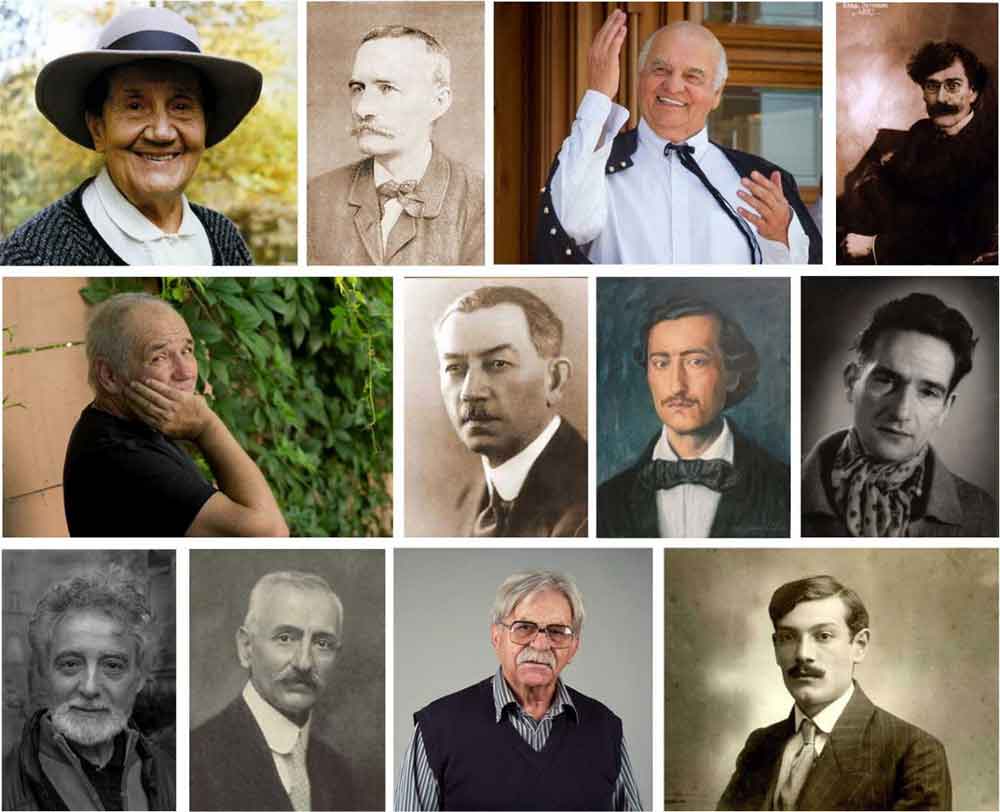
Calendars are one-year “plants”. Around the New Year, the old date sheet is replaced by a new one, which diligently reminds us of important days from the wall or desk. Calendar connoisseurs will search the sea of different ones for those whose motifs are in contemplation with their life interest or some longing. Thus, while the gaze is searching for some rounded Tuesday or holiday, the viewer’s thoughts easily go to a turquoise beach with palm trees, fishing in the Caucasus or in a high-class car with a very pleasant-looking escort.
Today, calendars generally do not occupy a central place in marketing. Companies and organizations share materials as part of their promotional packages, where calendars are often found. Selected from a general catalog, although visually appealing, calendars are creatively neglected. There are few truly original solutions that, using such a format, bring an interesting story, strongly convey a message and thus reflect the organizational culture and values of the calendar donors. However, like mini billboards, calendars have the potential to effectively send other, striking messages in addition to reminding viewers of dates every day.
The thesis “that something needs to be done with calendars in order to engage them more creatively” initiated our group’s determined intention to create a calendar with a “story and style”. We literally started by writing a “script” and good preparation, and then moved on to “snapshotting”. With this photo-verse-story, we want to bring you closer to the idea, but also to the very beautiful experience that creating a calendar inspired by poetry can provide.
Before you is a story about the corporate calendar of the company Elektroistok-Izgradnja “Serbia Painted with Poetry” for 2020 and a brief overview of the motifs, symbolism, and interesting facts about the process of its creation.
The calendar thematically relies on selected poetry by our prominent poets to evoke the character and culture of Serbia through photographs inspired by poems. The composed compositions of poems and scenes in the photographs express the so-called “cultural patriotism” by exalting the symbols of love, life, freedom, honor, knowledge, diversity… To some extent, the lyrical moments of death and suffering, indispensable in our patriotic poetry due to our turbulent history, national suffering and longing for freedom, are also depicted.
Along with photographs that visually evoke the poems and motifs of Serbia, the calendar pages feature a printout of a stanza or several verses. The goal is to inspire the viewer to, if they haven’t already, read or listen to the entire poem and then make a connection between the poet’s thoughts and our visualization of the verses. The compositions, composed in this way, should, in an unpretentious manner, challenge the viewer to imagine themselves in front of the scene and feel the emotion it carries with it, and evoke a sense of belonging to a culture.
The following lines tell the story of the creation and motif of each of the 13 photographs that make up the calendar, as well as some interesting facts about the poet, the poem, and the process of creating the image itself.
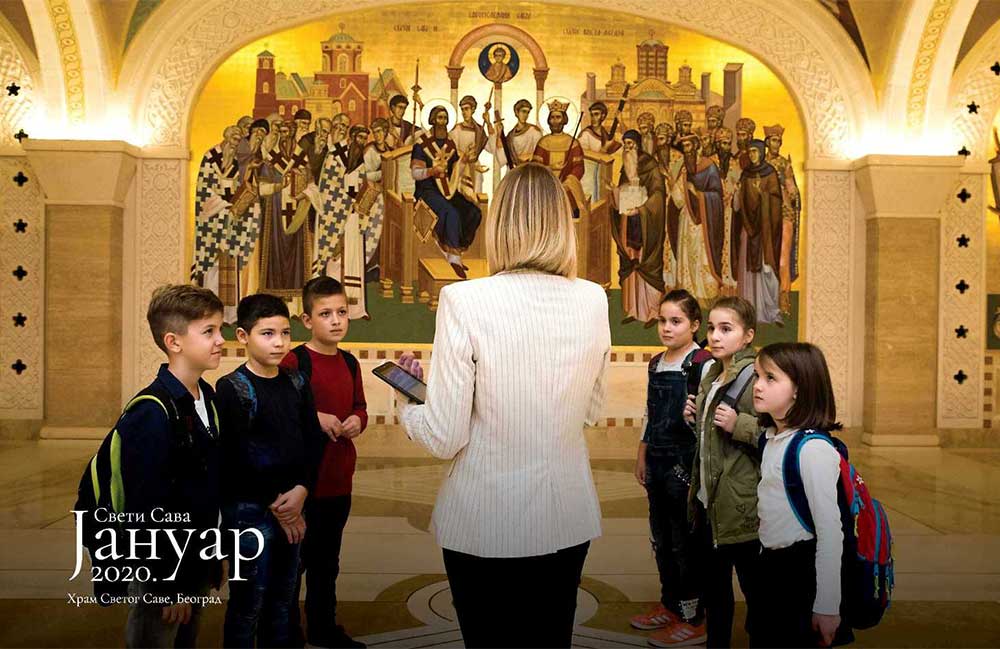
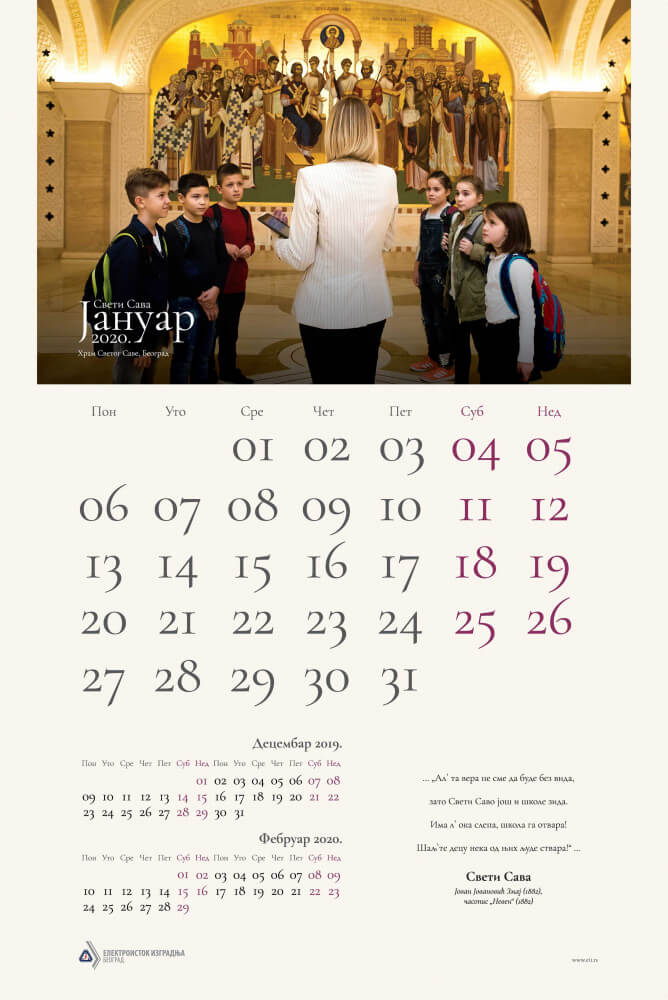
January is the month in which Saint Sava is celebrated. Jovan Jovanović Zmaj was an equally exceptional personality as Rastko Nemanjić, who together permeate Serbian history and culture in the brightest possible way. The combination found in their work and dedication to children and education fit perfectly. Uncle Jovo Zmaj’s verses indicate that faith, with its spiritual influence, should open new horizons through school and education. The photograph, created in the crypt of the Temple of Saint Sava, celebrates future generations and pays great respect to educators. “The glory of the students is the glory of the teacher.” ~ Latin proverb
Interesting fact: Behind the scenes of this photo, besides Mirjana, the “teacher” and the children: Divna, Jasna, Milica, Lazar T. Andrej and Lazar P., there were about a dozen other people. All participants in front of and behind the camera are employees of Elektroistok Izgradnja and their families, so the final photo is one of the company’s family portraits.
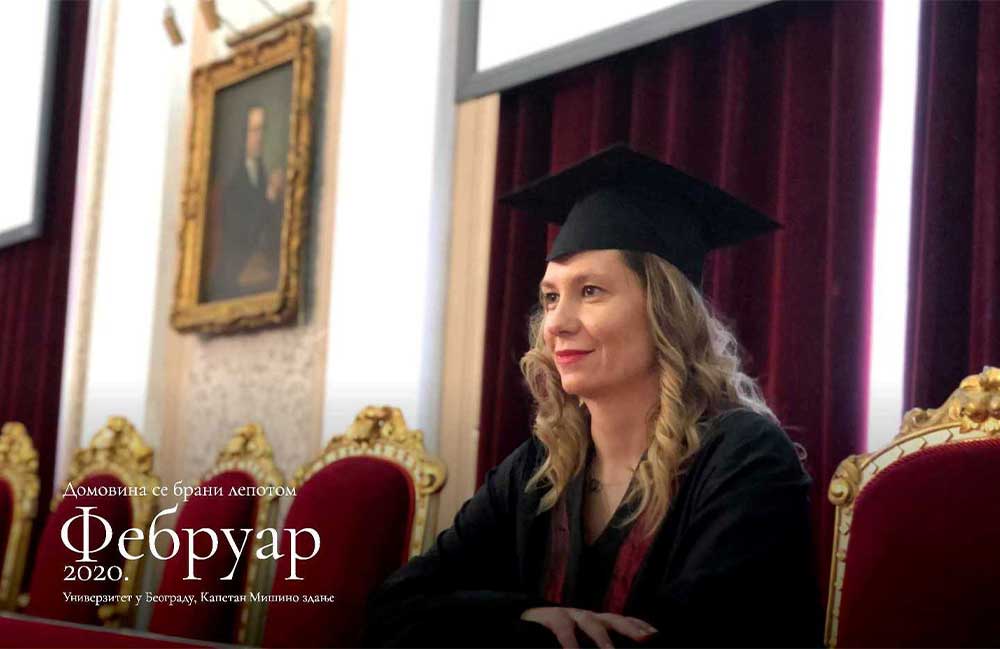
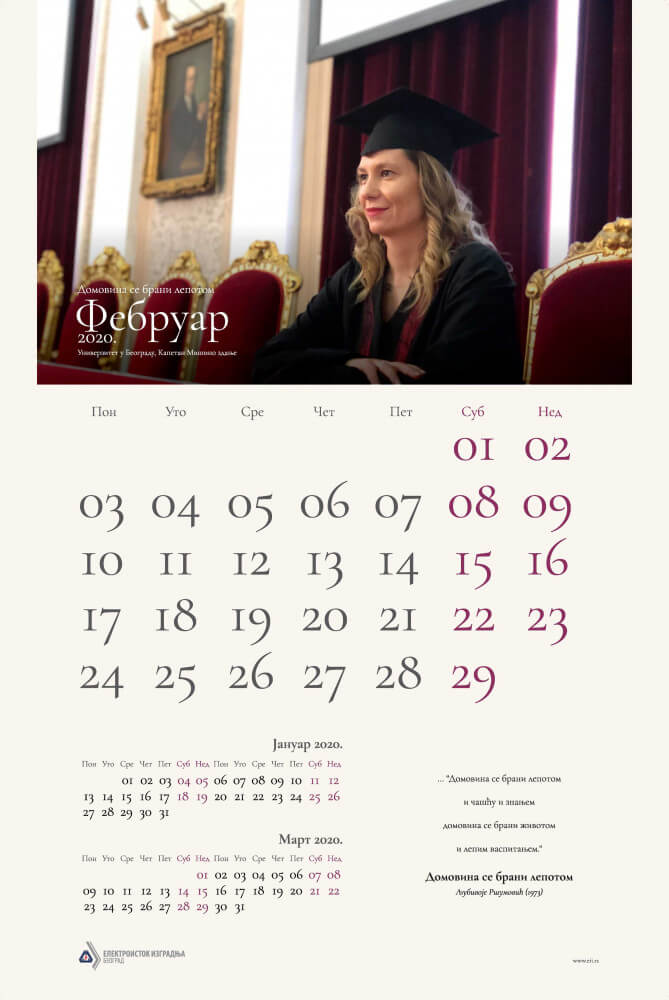
The poem “Homeland is Defended by Beauty” and the writer need no special introduction. There are no mustaches who have brought more joy to children, big and small, through their poems and “tricks and gimmicks” than the Ršums. We would add to one of Ršum’s remarks about this poem, “Well, didn’t Dostoevsky write that beauty will save the whole world?!” that it certainly will, but only with “knowledge and good upbringing.” The impression is that we made great use of the doctoral promotion of Jelena, the wife of our “director of photography” Bate, in which all the epithets from the poem were gathered. Dr. Jelena, the portrait of Dositej in the background, and the University of Belgrade are our human and artistic impression of Ršum’s thoughts. Our impression is that Uncle Ršum agreed with this, because he was very pleased with this calendar and asked for dozens of them.
Interesting fact: The first idea for the February scene was to take a photo of a member of the Serbian Army Guard with a saber on Čegar, in honor of the statehood of Serbia and the First Serbian Uprising, where we would have differently painted symbols and motifs of the same song. To our regret, and despite the goodwill of certain services of the Ministry of Defense, the Serbian Army did not give its consent for such an undertaking. That regret, fortunately, today is only an anecdote. Some doctorates are truly worth everyone “seeing”.
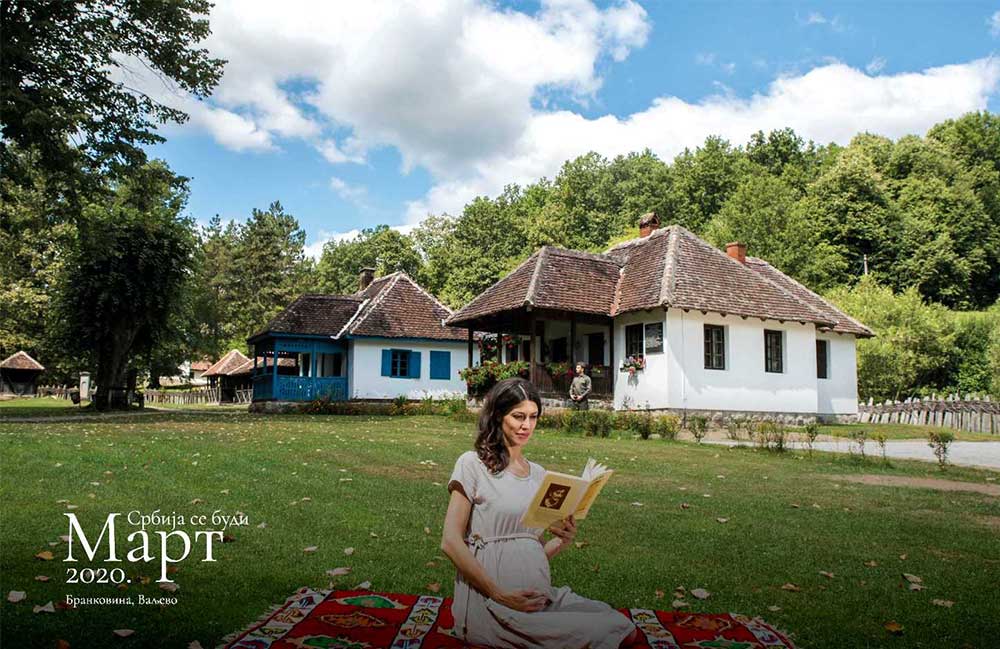
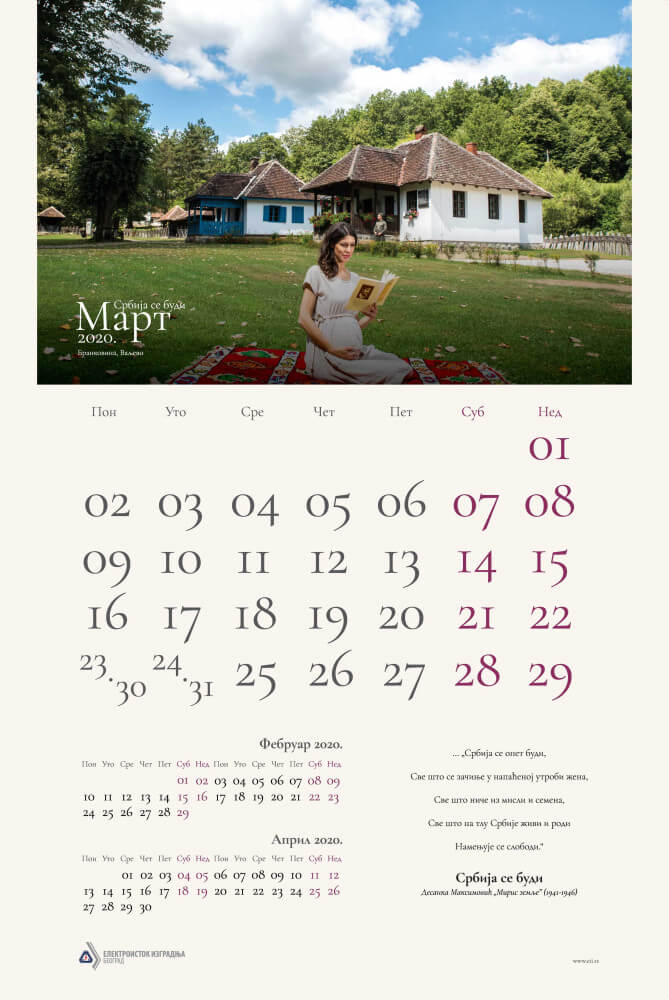
The literary anchor called Desanka Maksimović is deeply rooted in the cultural code of the people. The poem “Serbia Awakens”, woven from pure patriotism, was a great inspiration for the entire “artistic direction” of the calendar from the start. Desanka wrote this poem inspired by the NOB insurgents who operated in her native Brankovina. Through the kindness of the Valjevo National Museum and the museum staff, in the beautiful ambiance of Brankovina, we were given the opportunity to uniquely “capture” the symbolism of birth, fertility, freedom… through the image of the beautiful woman from Valjevo, Aleksandra, who was pregnant at that moment.
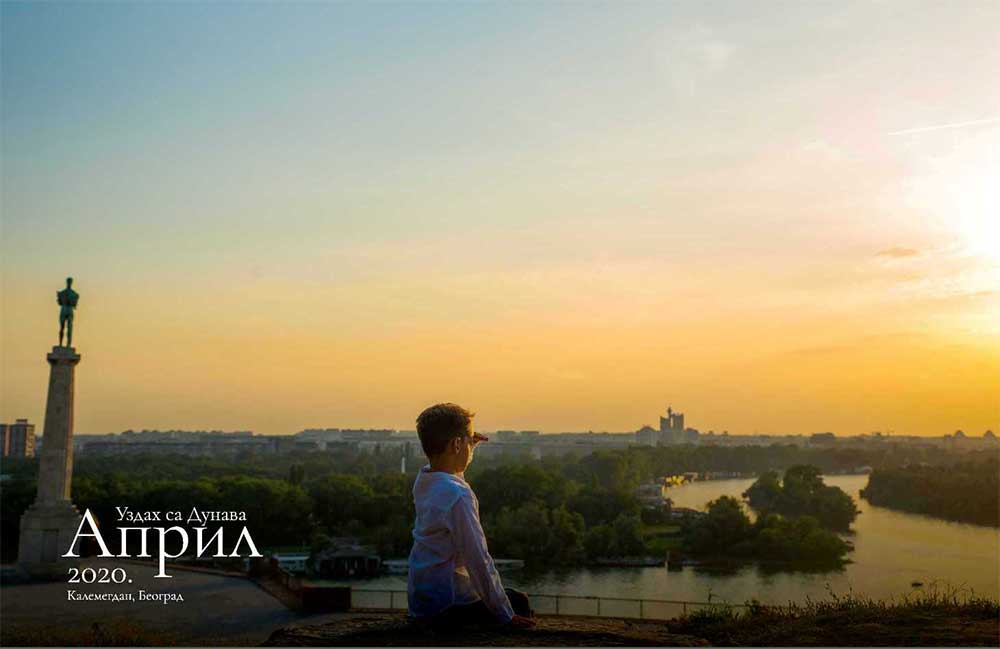
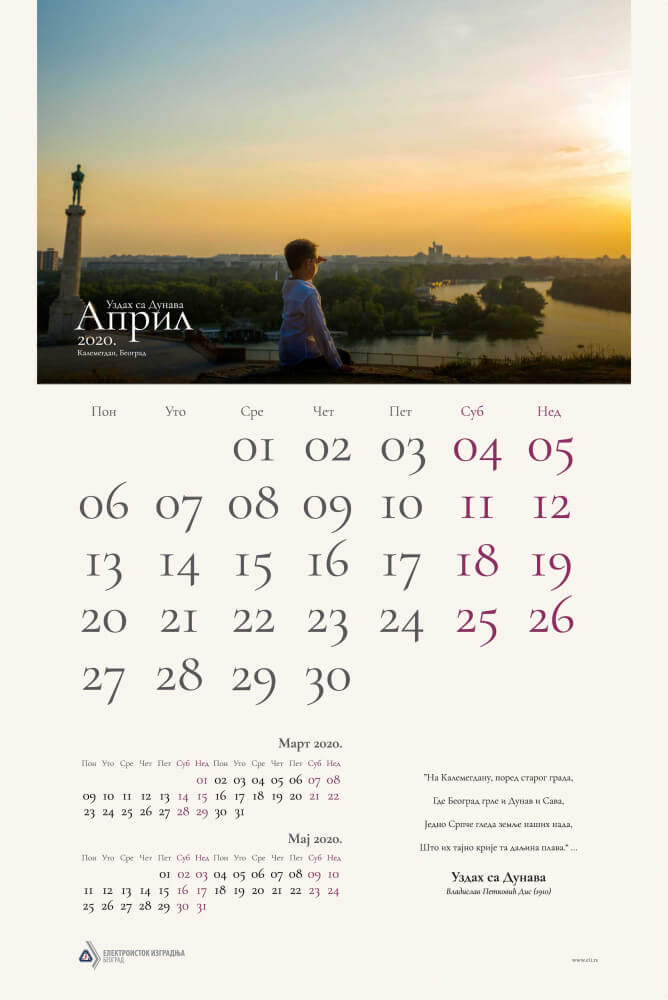
The verses of “Sigh from the Danube” are literally interpreted by the boy Nikola, who during the photo shoot was anything but “pensive” as the verses claim, but like every boy, elusive and fickle, resembling the life of DIS himself. Unique in style but not exactly approved by the contemporary poetic “elite” of the time, DIS found his poetic inspiration and support in the bohemian circles around Skadarlija. His personal fate, unfortunately, fits the model of many tragic poets of the time.
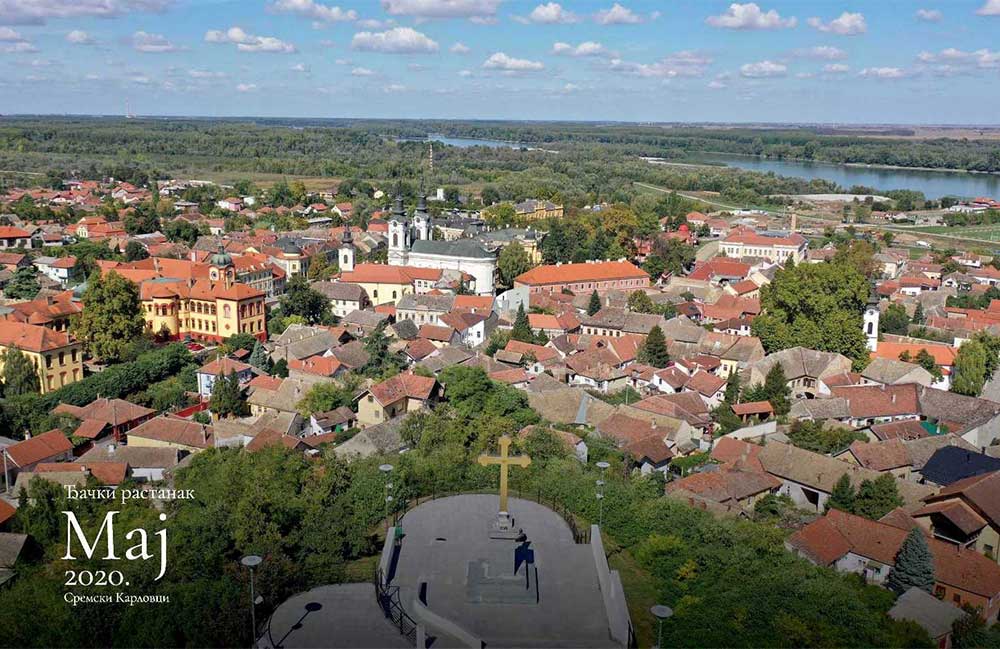
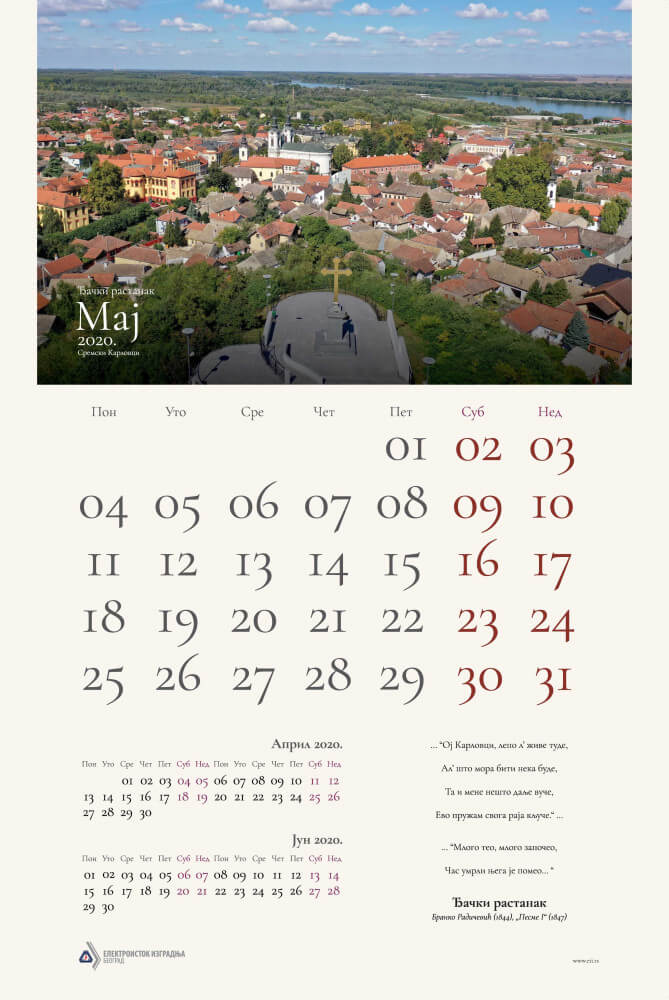
It seems that Branko Radičević has built a part of his soul and artistic talent into every stone of Fruška Gora. The poem “Students’ Farewell” is one of Branko’s most beautiful elegies and a direct address to the people of Sremski Karlovci and Fruška Gora, to which he was very attached throughout his life. The panorama of Sremski Karlovci radiates the deeply rooted history and culture of these parts of Serbia.
Interesting fact: An alternative verse from “Student Farewell” was part of the song…
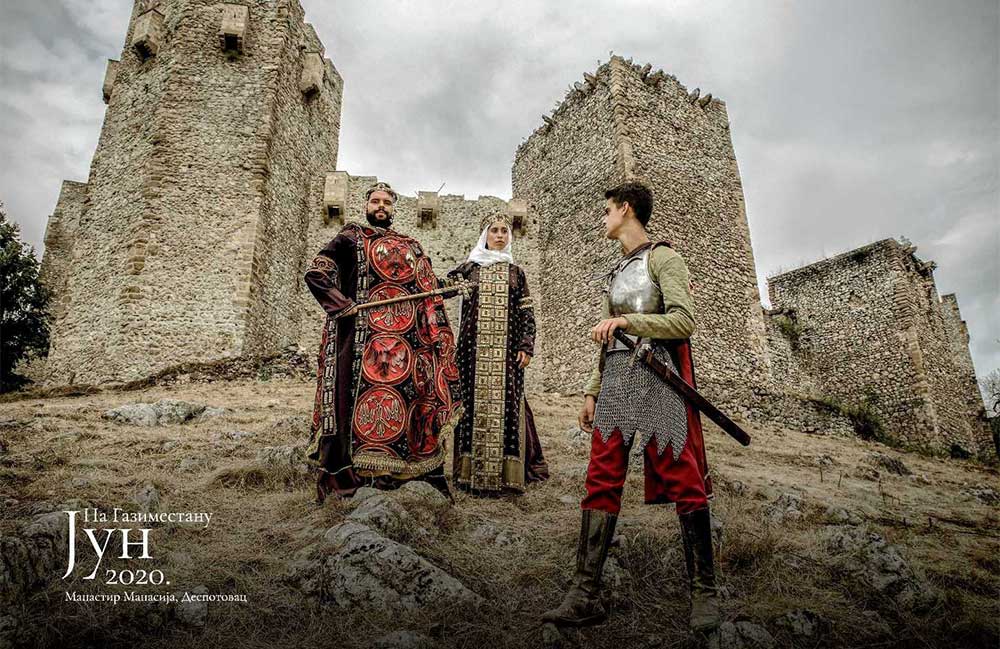
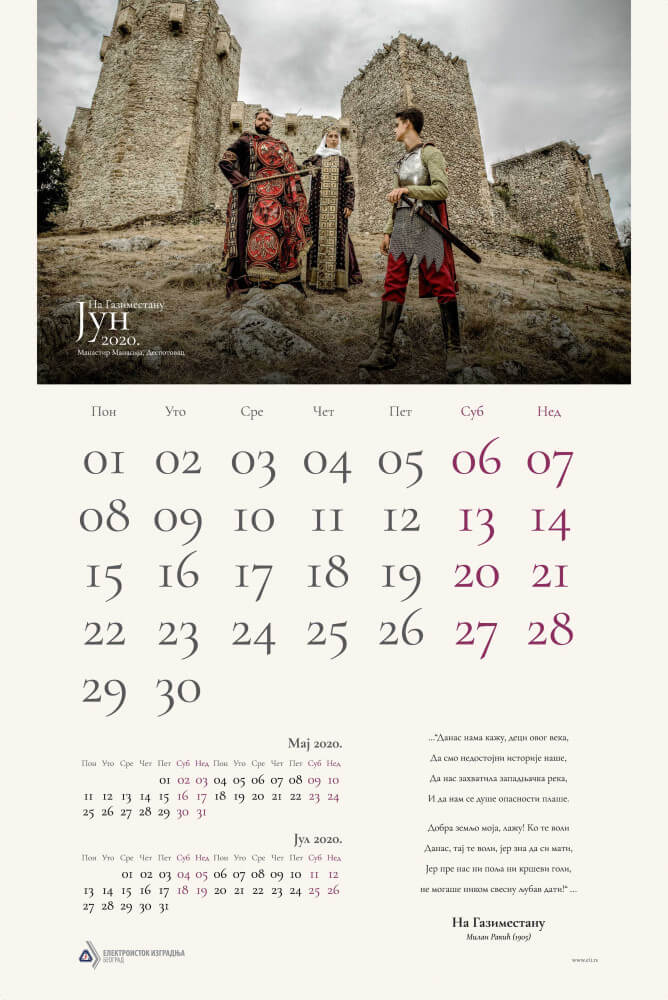
In his poem “Na Gazimestanu”, Milan Rakić expressed his deepest thoughts and emotions towards perhaps the greatest myth in Serbian history, the Battle of Kosovo. How untainted and pure the concept of patriotism was at that time is best described by this testimony by Rakić taken from the book Ratnici Crne ruke – besmrtna prednovnica, S. Pavlović, Novi Sad 2017, pp. 145-146:
“He was a volunteer in Vojvoda Vuk’s company. A small number of his comrades knew that the man who wrote the poem “Na Gazimestanu” (At Gazimestan), which they often recited in the moments before the battle, was fighting with them. Rakić describes his arrival at Kosovo Polje this way: “So we arrived at the very site of the Battle of Kosovo. On the right, the Lab was humming, full of new strength from the autumn rain, and was in a hurry to bring the great news. On the left, on the hill, the thoughtful tomb of Murat settled. We were lined up. The commander appeared, accompanied by the headquarters: “My heroes, do you know where you are? Do you know what this place is called?” In the tight formation, rifles clinked against rifles, shoulder straps tightened. “Here, where we are standing now, on St. Vitus’ Day in 1389, on the same day and at the same hour, both emperors were killed! That’s Gazimestan, where Obilić is…” Soldiers were falling around me. I looked up: they were kissing the ground! I guess I was also crouching down, when I didn’t notice where a young officer with a drawn saber came out of. He stopped in front of the commander, greeted, reported something, then turned to the line. He raised his saber and began loudly: “To Gazimestan from Milan Rakić!” First my hearing betrayed me, then my sight. A hill with a turbe rises in front of me, turns red and remains hanging like a flaming flag. It reveals me completely – a mountain! The sky was breaking with the shout. The new and young Serbia is celebrating Easter, and I? I was struggling to stay on my feet. I felt more than I saw when someone broke away from my unit and, running, arrived in front of the commander: “Mr. Colonel, the one who sang this song is here with us. Here he is in the back, with bombs, in Vojvoda Vuk’s detachment!” And immediately the commander’s voice echoed: “Volunteer Rakić, forward!” I heard everything, but I couldn’t even take a step. I couldn’t even open my mouth. I covered my face with the sleeve of my overcoat and shed tears, for the first and last time then.”
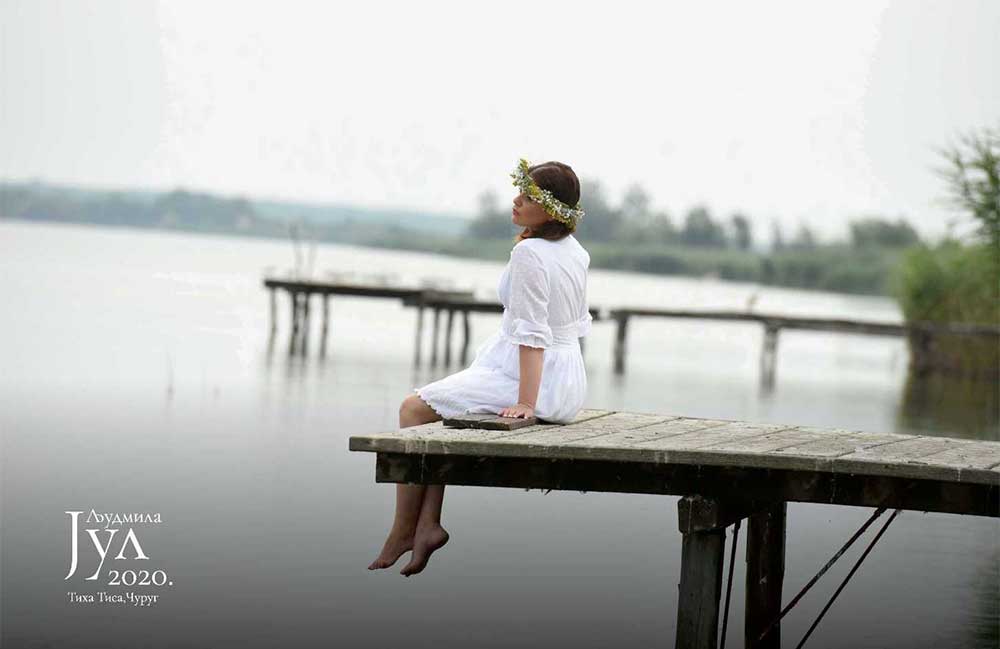
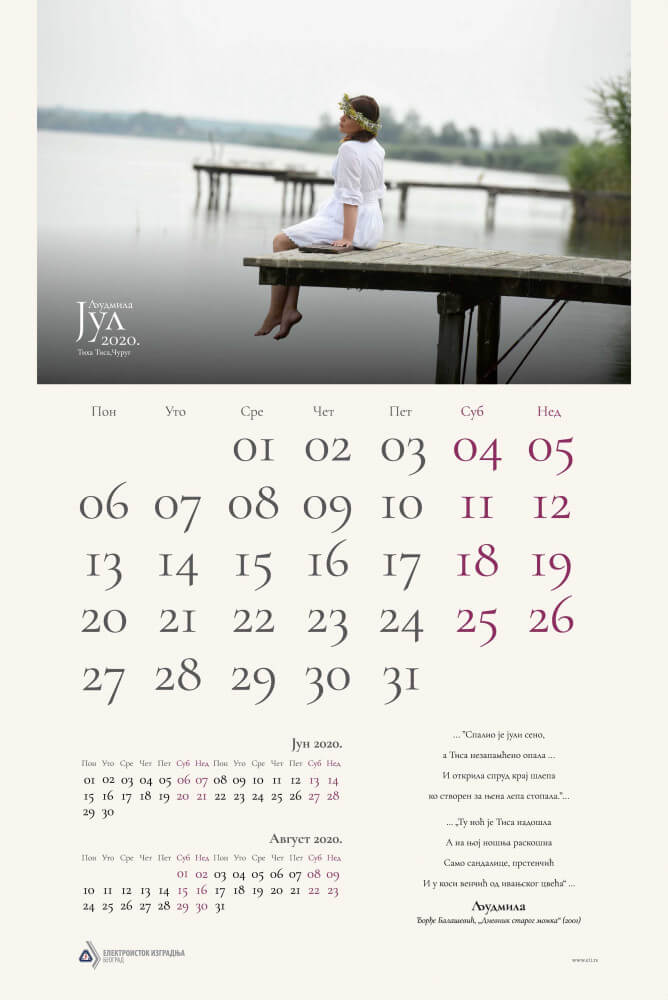
No one gives such a clear picture of the idyll of the plains mixed with the sorrows of love as Balašević. The song “Ljudmila” brings the Tisa to life during July with all the diversity of the people who live around it. Good preparation and visiting the locality before the day of the photo shoot helped make the final selection of photos a sweet torment for the entire calendar team. The character of the enchanting Ljudmila was played by one Bogdana, without whose production and spousal support the entire calendar would have no beginning, no end, and let me say, “that sense.” The family production of this calendar also remembers one “brother-in-law” Stevo, without whose organization, visiting the fields in the heat, rowing in the rain, and Čuruše hospitality, we would not have had the opportunity to see either the fallen or the recovered Tisa.
Interesting fact: The original plan for the photo was to show Ljudmila’s father in the background, described in verse as “her old man was a boatman, half Romanian, half Hungarian, a furious daughter”. Everything had been arranged the day before with a certain local man, Mr. Milet Kostić, who, with his wiry arms and angry and sullen face, looked as if he had stepped out of a poem. But alas, at the agreed time the next afternoon, Mr. Milet did not appear and the photo had to be taken. Then, they say, that morning he went to make brandy with a neighbor… The wreath of St. John’s wort was not really made of St. John’s wort, because by that time the St. John’s wort had already passed. Some skillful hands nevertheless wove it to decorate the beautiful face of the seductress.
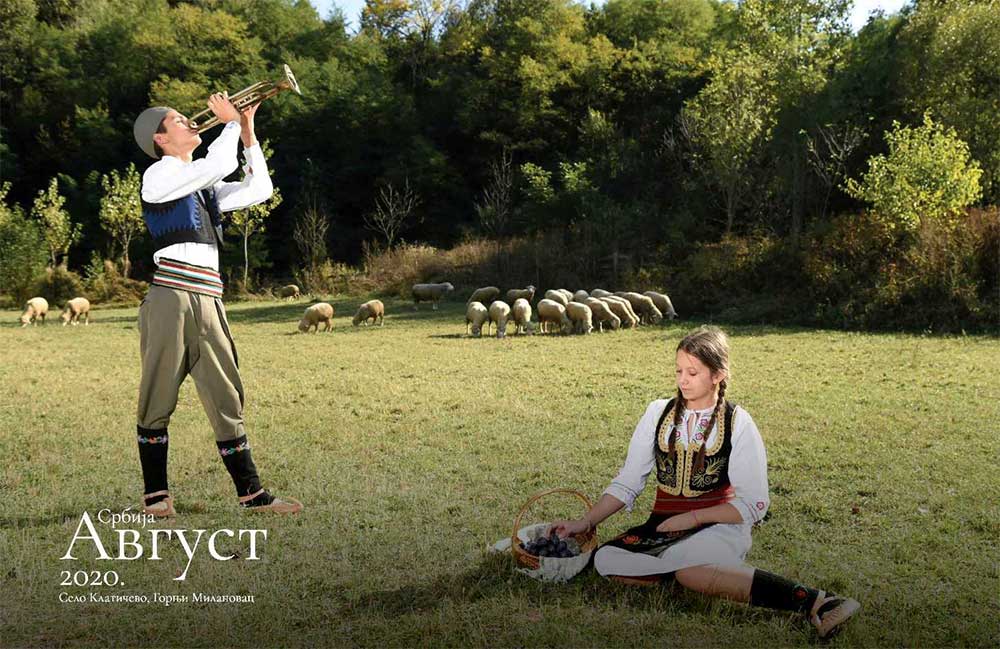
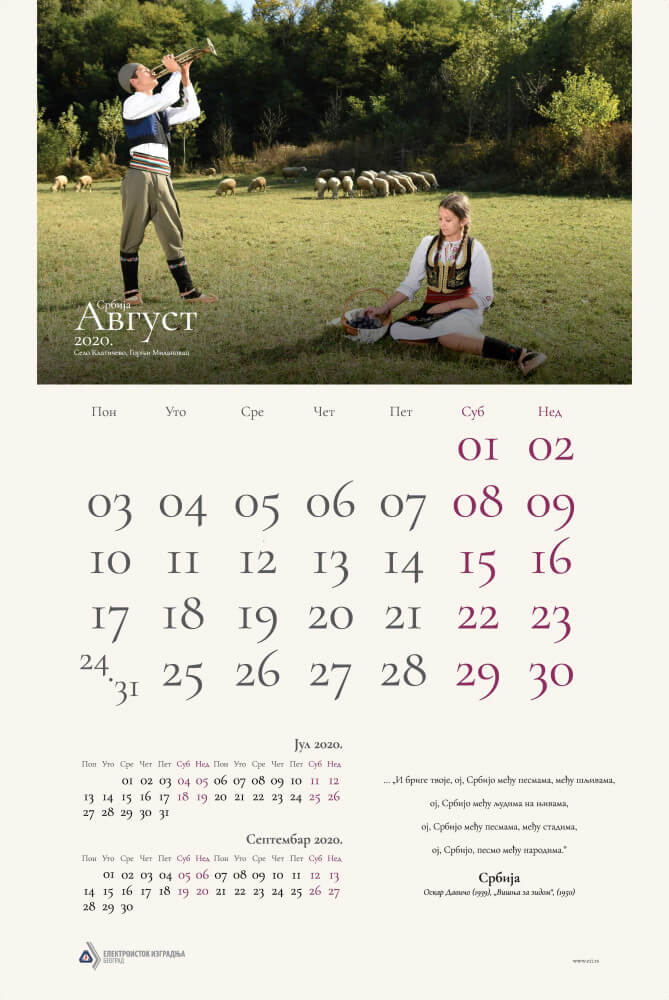
In his poem “Serbia”, Oskar Davičo, like a poet-psychologist, completely reveals and describes all the flaws, virtues and secrets of the mentality of the people of this area that exist timeless. It is easy to capture beautiful children, a song and a plum in one photograph, but together with a peaceful flock, it is the result of the ultimate efforts of 6-7 people and one dog in pursuit of sheep. With the great help of the Gornji Milanovac Tourist Organization and the cultural and artistic society, but above all with the efforts of our colleague Jovan, a photograph was created in which Tara and Uroš in the foreground most beautifully revive Oskar’s verses Oooj Sbijooo…
Interesting fact: We would like to thank our colleague Jovan who was willing and skilled to catch the young lamb and release it so that we could have an alternative photo. The effort certainly paid off in the clearing of the village of Klatičevo, but the lamb was still returned to its worried mother sheep.
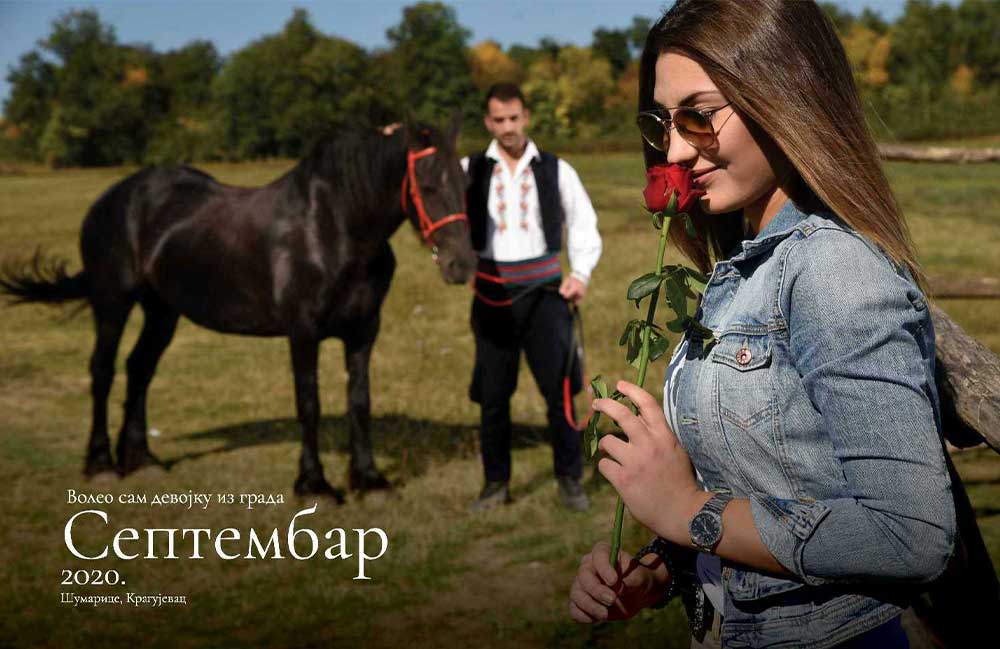
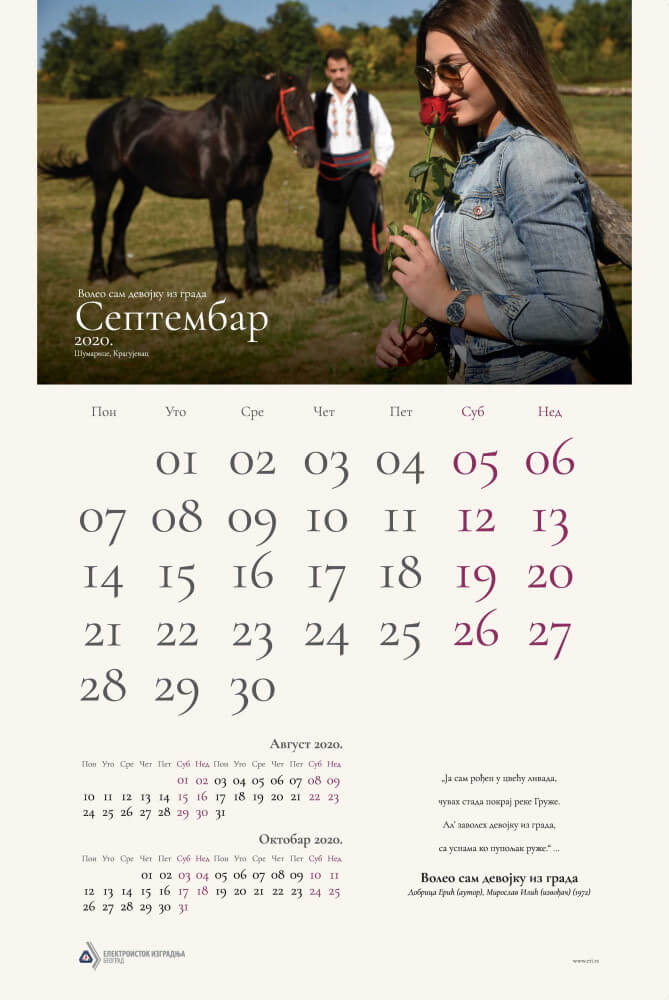
The photo of the month for September, “I Loved a Girl from the City,” is a tribute to a poem by Dobrica Erić that has settled deep into the souls of all bohemians and is sung with the same intensity that only Miroslav Ilić has. The Gružan region was an excellent host, especially Bojan, the owner of the stud farm and the Kraguj Equestrian Club. Anastasija and Marko, the youth and future of Elektroistok Izgradnje, masterfully “played” the entire village-city-village love affair with a beautiful black AT, Vranac.
Interesting fact: Vranac is actually a black horse, Imka’s mare. An unusually calm and docile mare that, in addition to her unreal beauty, we can recommend to any film production due to her exceptional cooperation during photography. Real, well-behaved horses are actually not as stubborn as they say.
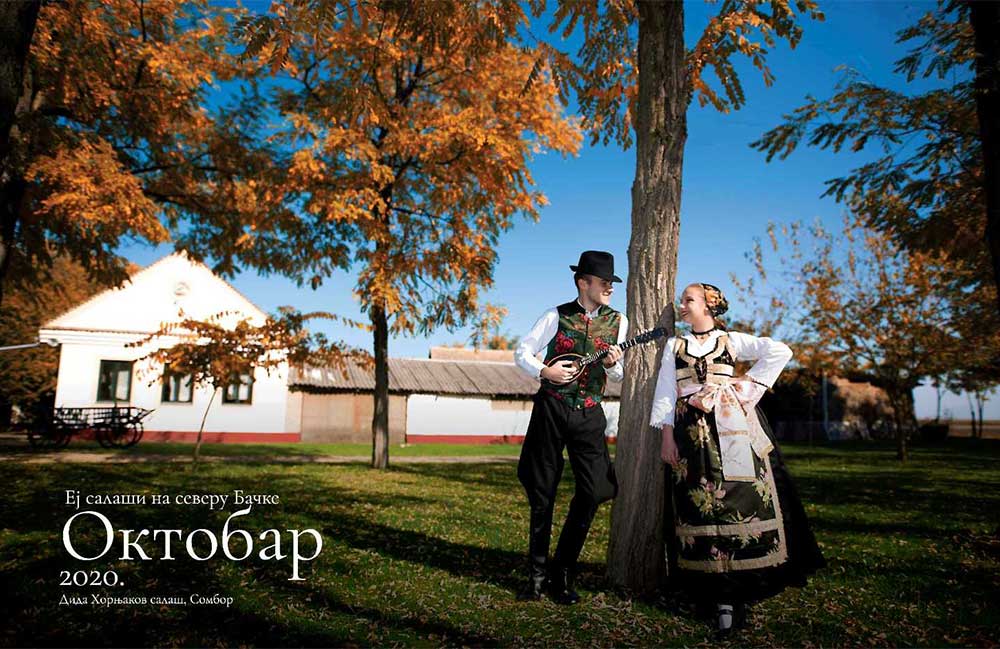
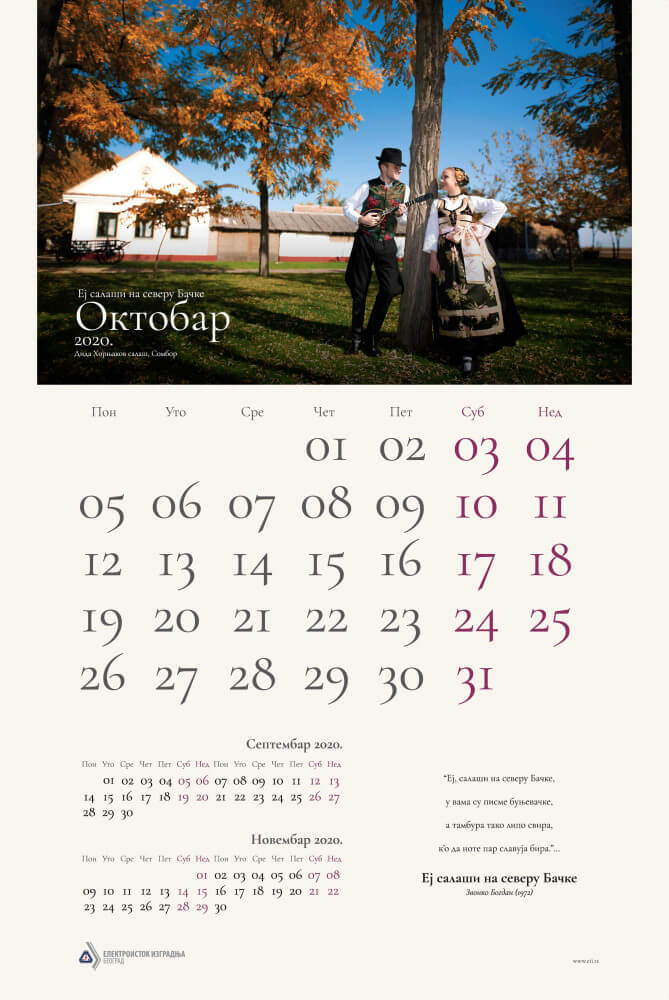
In order not to repeat ourselves, it is best to read a brief testimony about the poem “Hey Farms in the North of Bačka” by the great Mr. Zvonko Bogdan, which can be found here:
http://www.yugopapir.com/2014/09/zvonko-bogdan-kompozitor-kako-sam.html
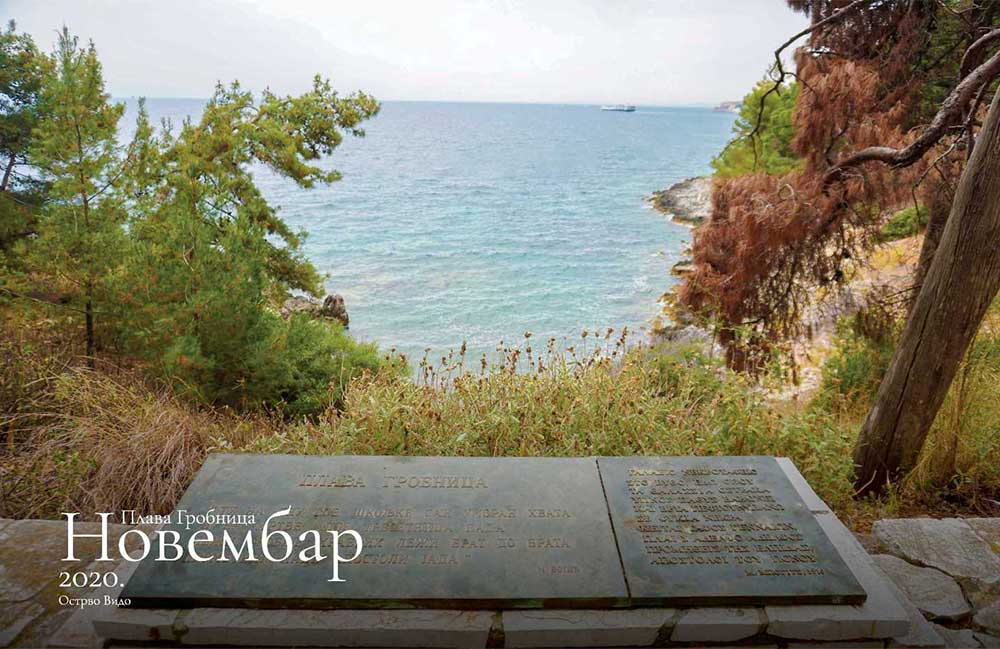
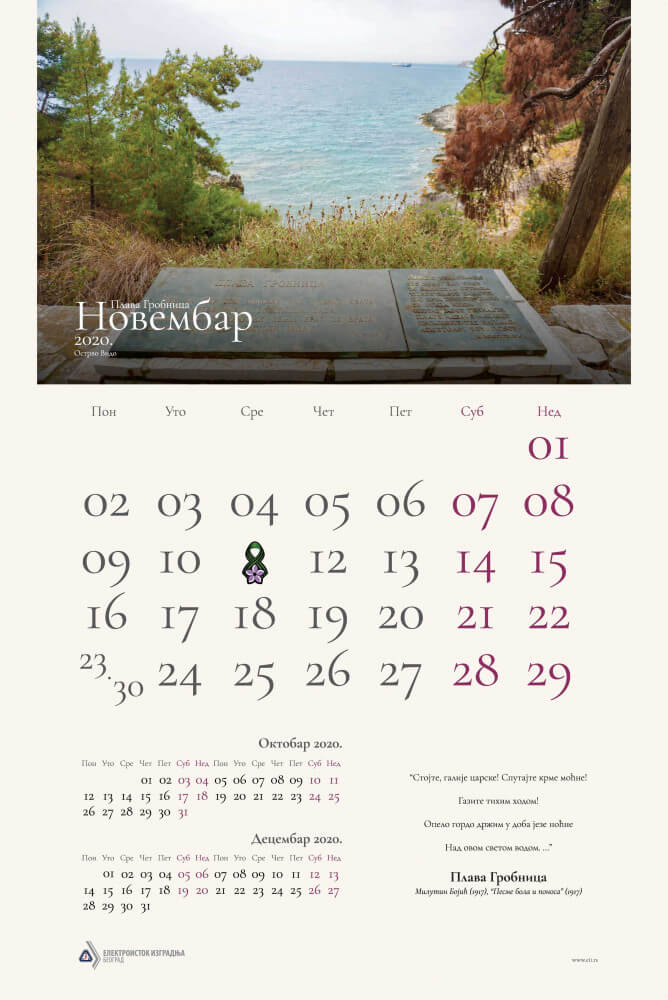
In honor of the victims of the First World War, Milutin Bojić’s poem “The Blue Tomb” was not without its alternatives or doubts about the choice for the “November” page of the month when Armistice Day is celebrated. A passage from the Wikipedia article on Milutin Bojić gives the best catchphrase about this poet: “Although he lived only 25 years (Milutin Bojić), he left an indelible mark on Serbian literature. In his short life, he still managed to sing of the suffering and agony of the Serbian people through the tragic retreat through Albania, and in this way he immortalized the eerie vision of the blue tomb near the island of Vida – the island of death. But he did not live to sing of the victories and liberation in which he firmly believed. Death found him at the moment of his strong poetic rise.
Interesting fact: Our photo maestro Bata’s first idea that the image of the “restrained mighty stern” in the vicinity of the islands of Corfu or Vida did not come to life. However, the scene of the famous tablet with the inscription of the poem “Blue Tomb” from the island of Vida leaves a strong impression of the tragedy of a people for not forgetting, deep affection and eternal respect.
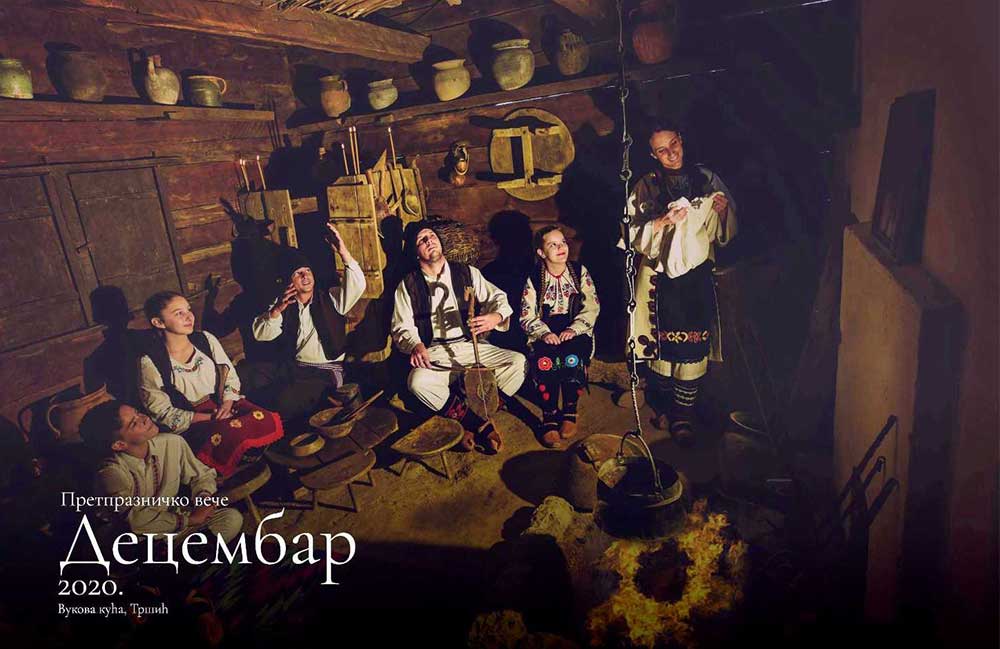
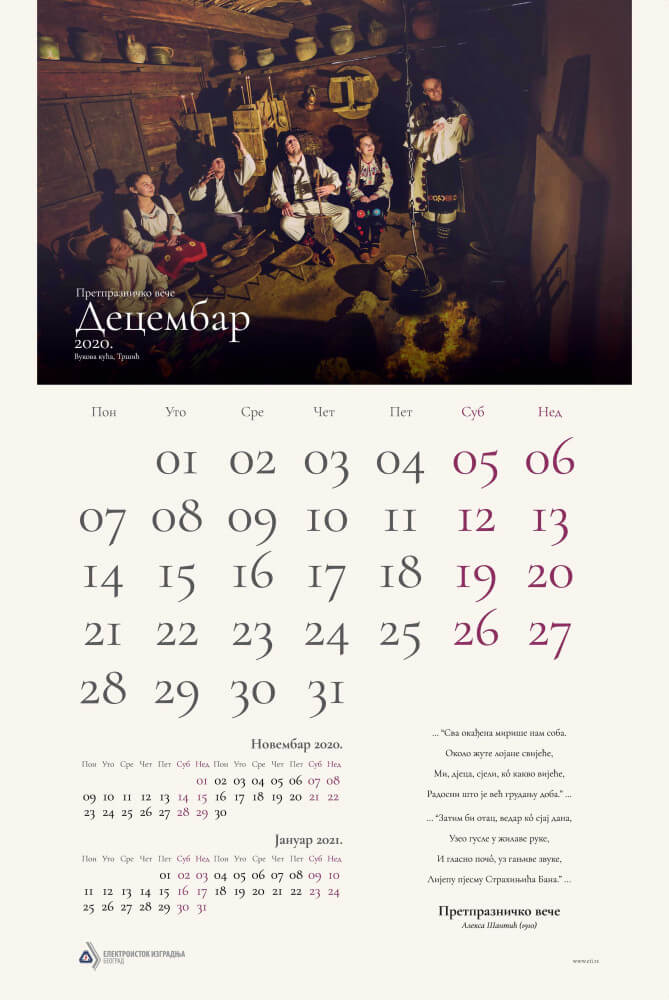
The photograph planned for the calendar “December” was the author’s greatest artistic challenge and, if you will, also personally, due to his special affection for Aleksa Šantić, and brought the most anxiety about its realization. However, Šantić’s “Pre-Christmas Evening” is such a descriptive and inspiring poem that uniquely depicts the festive spirit of the month of December, that the vision for the photograph was impeccably clear. On the other hand, we were very fortunate in the production in the selfless consent and help of Mrs. Vesna Marjanović, our famous ethnographer, who advised, recommended and provided the location and collaborators according to the idea. The Vuk Karadžić Loznica Cultural Center generously allowed Šantić to portray his memories of family and festive warmth when he was a boy in Vuk’s house. Marija, Šantić’s “mother” from the photo, a girl of indescribable energy, with unimaginable ease, organized, dressed, and even transported Sara, Katarina, Darko, Aleksandar, and Đorđe, the protagonists of the family of young “Alexa”, so that everything else flowed like the “tallow candles” from Šantić’s ballad.
Interesting fact: Technically, this photo was also the most demanding. The lighting and finishing highlighted Bata’s photography and editing skills. The spotlight that provided realistic light in the room was digitally removed, while the fire in the fireplace was inserted so that it radiated light into the room and revealed the well-being on the faces of Šantić’s family.
Насловна фотографија календара „сликаног поезијом“ у комбинацији са чувеним стиховима Душана Васиљева целу причу ставља под свод планине Голије и земље Србије. Током истраживања и писања сценарија за календар Душан Васиљев, његов песнички опус, рад и генерално живот су били откриће вредно сваког помена и насловног места у календару. Поред чувених стихова саме насловне песме „Домовина“ пажњу привлачи карактер овог младо преминулог Кикинђана, експресионисте антиратне оријентације и уметничке душе заточене у безнађу служења аустроугарске војске.
Interesting fact: Although the original plan was to take the photo on a moderately and “picturesque” cloudy day at the highest peak of Golija, Jankov Kamen, in order to get a beautiful panorama of Golija that would fit in with the lyrics “it is love for the cloud that floats here for the song that spreads here”… the calendar expedition learned the hard way that before setting off on a journey over the mountain, even in the summer months, one should consult AMSS. During that period, the road over Golija was being completely reconstructed, so after a long and bumpy ride over gravel, we still reached Dajićki Jezer, where we managed to take a picturesque and cloud-filled photo with the help of a drone.
The process of creating the calendar was an almost surreal experience… from researching the poet, poetry, selecting verses and scene plans, organization to the final opening of the camera shutter and design details. The final product sends a message to all the people who participated in its creation about the importance of nurturing culture and the literary word in a time when it is suppressed and sometimes even desecrated by the “mainstream” media. However, such valuable messages are immediately recognizable despite the daily dense noise of kitsch, fake news and drawing public attention to “low passions”. Proof of this is the calendar “Serbia Painted with Poetry”, which was printed in a circulation of 1000 wall copies and 500 table copies, and was literally looted. True, the publication was not of a commercial nature, so the calendars were exclusively given away and distributed to friends and partners of the Elektroistok Izgradnja company, but always with a request to receive an extra piece. Copies were sent to all living poets or living families of deceased poets.
With this testimony, we also record the unanimous conclusion of the calendar team that the most valuable thing of all is actually the enthusiasm and unreserved support of all the people who helped make this project a reality. Everything you saw in this calendar was only asked for with kind words, and “paid” for with friendly encounters and laughter without a single dinar being spent.
Culture awakens nobility in people, nourishes the soul and gives only the most beautiful gifts! A calendar will be able to “sing” about this until the end of 2020! We don’t plan to stop there.
Ivan Jovanov, part of the team
Credit for creating the “Serbia Painted by Poetry” calendar for 2020. year
Production: Elektroistok Izgradnja DOO Belgrade, Director: Radiša Kostić; Sales and Marketing Department, Author: Ivan Jovanov, Preparation: Jovan Tomić; Photography: Milan Jovanović – Bata (Memories by Bata); Design: Vladimir Popović
The “Cultural Patriotism” calendar is the fruit of the effort and enthusiasm of all participants, the characters in the photos, and the friends who made the creation of the calendar possible without any compensation.
Gratitude
Intellectual Property Office of the Republic of Serbia; National Museum Valjevo; Association for the Preservation of Old Crafts and Skills “White Eagles”; Festival “Just Out”; Fish Tavern “Tiha Tisa”, Čurug; Tourist Organization Gornji Milanovac; Cultural Association “Šumadija”, Gornji Milanovac; Equestrian Club “Kraguj”, Kragujevac; Dida Hornjakov Salaš; Cultural Association “Ravangrad”, Sombor; Cultural Center “Vuk Karadžić” Loznica; Cultural Association “Karadžić” Loznica.
Characters in photos
January: Teacher: Mirjana Palikuća, children: Divna Đorđević, Jasna Đorđević, Milica Palikuća, Lazar Palikuća, Andrej Šimpraga, Lazar Tomić; February: Jelena Novaković Jovanović, doctor of biological sciences; March: pregnant woman: Aleksandra Pavić, NOB fighter: Ivan Jovanov; April: boy: Nikola Jovanović; June: Princess Milica: Aleksandra Vukadinović, Prince Lazar: Lazar Vasilov, Despot Stefan Lazarević: Mihailo Mitrović; July: Ljudmila: Bogdana Mladenović Jovanov; August: girl: Tara Jovanović, trumpeter boy: Uroš Vasiljević; September: girl from the city: Anastasia Šimpraga, boy from the village: Marko Janković, black horse: mare Imke; October: Bunjevci, girl: Sanja Tordi, boy: Stefan Čapo; December: young Aleksa Šantić: Darko Šaulić, mother: Marija Nikolić, father-gudlar: Đorđe Nikolić; neighbor: Aleksandar Cvetinović, sisters: Sara Savić and Katarina Lukić.
Copyright
Pursuant to Article 49 of the Copyright and Related Rights Act, the conditions regarding the public communication of short excerpts of a work of authorship (right of quotation) without the permission of the author and without payment of royalties have been met. All rights to download and copy the calendar in its entirety reserved.